
Greek names reflect a long history and an unbroken line of centuries within a family.
Usually, when a child is born it is given the name of its grandmother or grandfather accordingly, although lately some modern couples tend to break the tradition and the naming rule, choosing names they like.
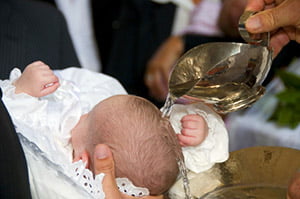
The name is given to the child by baptism at the church during the first 6-8 months of its life, although there is civil procedure too, which doesn’t involve the church.
Name Days in Greece
 In Greece everyone celebrates his name day; according to the Greek Orthodox Church, every day of the year is dedicated to the memory of a Saint or martyr of the church, therefore the name carries the Saint’s name.
The bearers of this name celebrate their nameday every year on the exact same date; if somebody is named Alexandros will celebrate his nameday on August 30th or if she is Marina on July 17th. Some name days are floating though, and change each year based on the Easter or other celebrations.
During the name day Greeks organize celebrations at an open home or elsewhere, where everyone can go and wish them for their name, while gifts are given; meals, drinks and dances also go.
- Read more about Greek Name Days
Greek Names in Different Versions
Greek names derive mostly from the Orthodox Church Calendars, although many Greeks bear names of Greek Gods and important personalities and mythological individuals of the rich Greek Ancient History. Especially today there is a tendency to give ancient Greek names to newborns, as increasingly more people acknowledge their special charm.
Greek names come in different versions; although there is one “basic” name, there are numerous nicknames produced and used. Some of them derive from the tradition, some other from jokes, or some others reflect a cute regard.
Therefore, you might see many people celebrating their name day at the same day, while their names are somewhat different; the secret is that they have different nicknames for the same baptismal name. Depending on the region of origin or other denominators, the same name can have many different versions.
Follow us on an exploration and explanation of the most commonly used Greek Names.
Hello!
Is it unusual to call people by their “basic names” in Greece? Are for example all family members called by their nicknames? I’m writing a story about a Greek family, so that’s why I’m asking..
Thank you :D!
Hi,
no, it is common to call people by their original first names instead of nicknames.
Yannis
You guys should make a place on the site to suggest Greek names that have not been added yet.
I am suggesting Avyi / Avgi meaning ‘dawn’.(Aυγή)
Dear Gary,
Triandafillο (τριαντάφυλλο) means rose in greek.
Trianda (τριάντα) means 30.
Fillο (φύλλο) means leave or petal.
So here it means 30 petals. When you take apart a rose it has a lot of petals, rose-leaves.
filos (φίλος) means friend.
x
Reka
Interesting info! However, I wish the pic of baptism above was a Greek Orthodox (submersion, not just the head)
Hi.could you tell me what the rules are for baptising. we want to pick a name that is not greek by any stretch of the imagination but don’t know if we can baptise in greek orthodox church. Help please.
hi, need to know the origin and meaning of the name Triendefillia (thirty friends)
Gary hi, i will look for that, i only know the name Triandafyllia which means Rose – as the flower Rose. But i will check if there is something about thirty friends!
Okay so could I know where you got this information from. I need to cite it for an essay.
Well i got the information from various sources, there is not one particular link or book i can tell you about. Basically it’s a matter of research. You can cite our website in your essay 🙂
My great grandfather came from Greece in late 1800’s. Their last name was changed like most foreigners who came here. We don’t have much info on our Greek family.